Genealogy research is more than just following hints and attaching records to people.
CensusTools spreadsheets give you the tools to uncover valuable information that is hidden in plain view.
Why you should transcribe census records
Transcribing census records into blank spreadsheet templates is the best way to:
- avoid repeating errors recorded by indexers
- prevent overlooking relevant information
- be sure you are including all pages of census data
- familiarize yourself with your ancestor’s friends, acquaintances, and neighbors
- track your ancestor over time
- prevent assumptions of information not stated
- reconstruct neighborhoods by combining census data with city directories
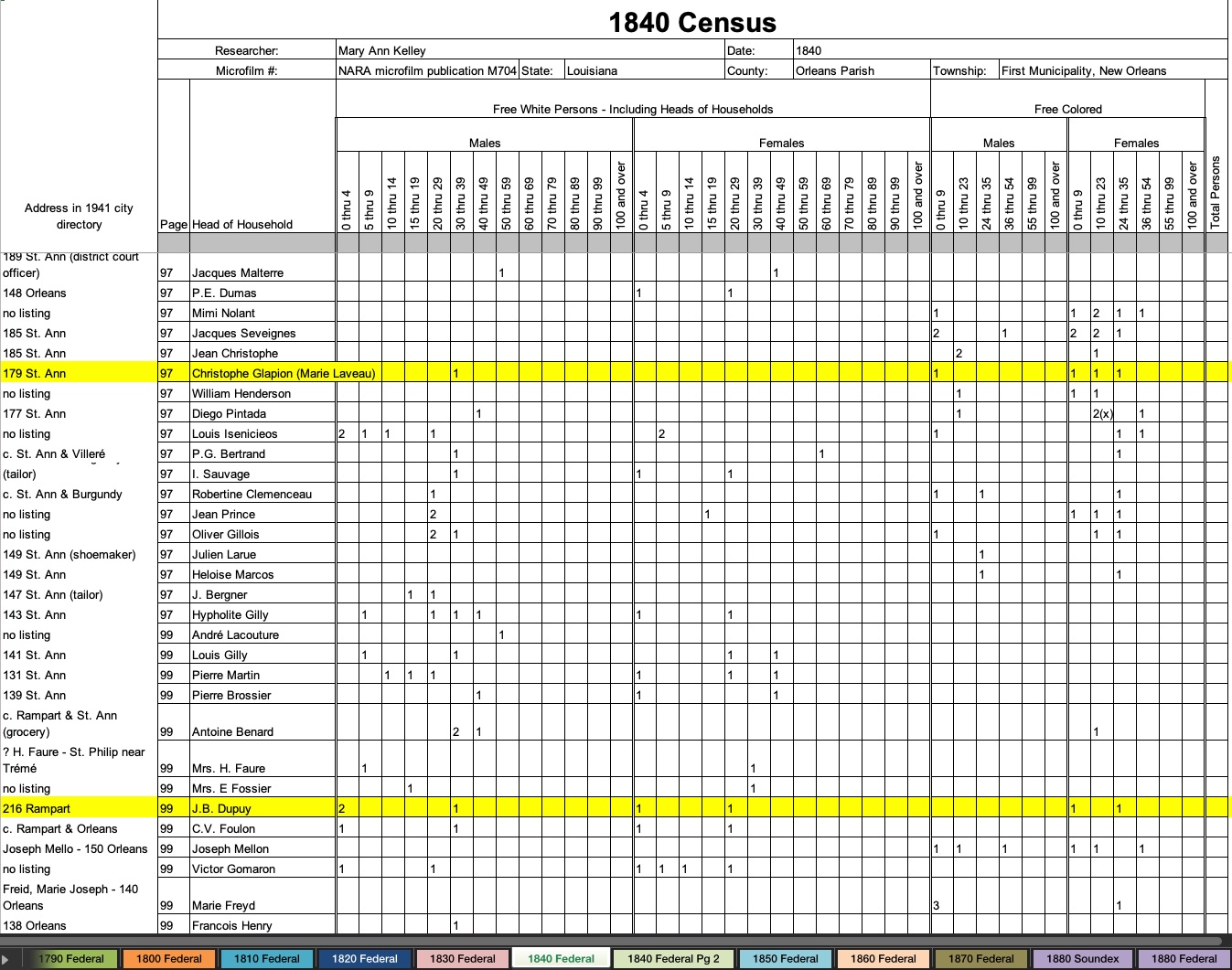
Transcribing the 1840 census for Jean Baptiste Dupuy and comparing it with the 1841 city directory for New Orleans highlighted that he lived just around the corner the Christophe Glapion residence, where Marie Laveau resided at the same time
CensusTools blank spreadsheet templates:
- make transcriptions easy
- give you a digital, searchable copy of data
- prevent you from having to decipher the same hard-to-read handwritten documents over and over
- allow each individual and/or family group to have a single workbook with all relevant census data
CensusTools blank spreadsheet templates include:
- U.S. federal population censuses for 1790-1950
- U.S. federal slave schedules for 1850 & 1860
- U.S. federal mortality schedules for 1850-1880
- U.S. federal 1883 Pension Roll
- 1890 census of Union veterans and widows
- Canada population censuses for 1851-1921
- England population censuses for 1841-1901
- Ireland population censuses for 1821-1911
- Scotland population censuses for 1841-1891
- Iowa population censuses for 1836-1925
- Kansas population censuses for 1865-1925
- Massachusetts population censuses for 1855-1865
- Minnesota population censuses for 1849-1895
- New Jersey population censuses for 1855-1915
- New York population censuses for 1825-1925
- Rhode Island population censuses for 1865-1935
- Wisconsin population censuses for 1836-1905
- Trackers and checklists for all of the above containing more than two census years
What information have you overlooked in censuses?
Find out with CensusTools spreadsheets — you get all 40+ spreadsheets for only $11.95! Get started now.
Requirements
All CensusTools spreadsheets were created with MS Excel and saved in Excel 97 format. A version of MS Excel for PC or MAC at least as recent as 97 is required to use the spreadsheets. PDF versions of all worksheets are included for anyone without access to MS Excel or for those who just want high-quality extraction sheets.